
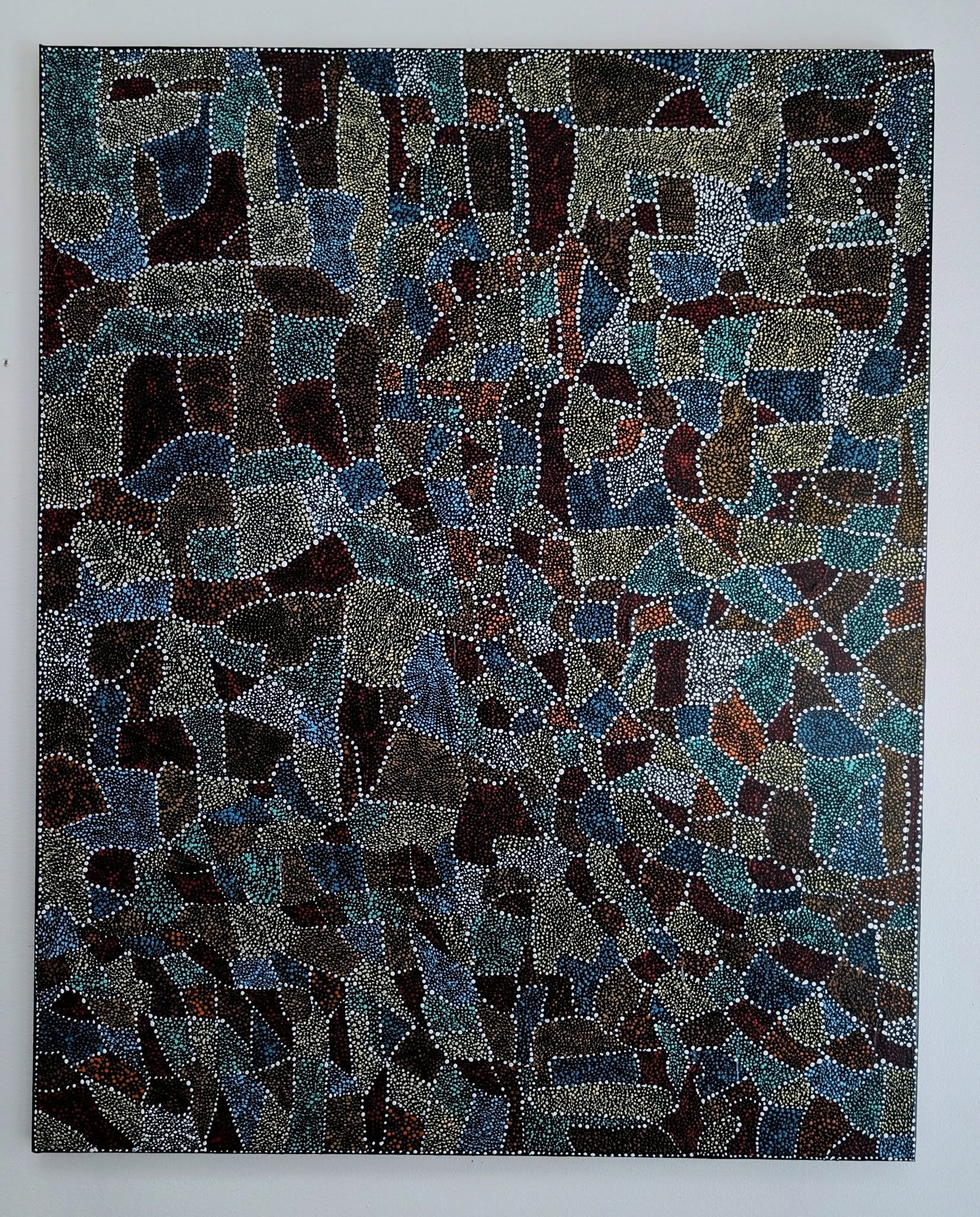
NOTE: This painting is currently on display at the Glengarry Market, 90 Main St. South, Alexandria, Ontario
This painting is a striking example of contemporary Australian Aboriginal dot painting, a style deeply rooted in Indigenous traditions from the Central and Western Desert regions.
The composition fills a large rectangular canvas with an intricate, all-over field of tiny to small dots in varying sizes, creating a vibrant yet meditative surface that seems to shimmer and pulse with energy the longer you look at it. The dots are densely applied — almost pointillist in their density — and form irregular, organic patches and zones rather than rigid geometric shapes.
The colour palette is rich and earthy with a cool twist:
Dominant deep browns and ochres (ranging from chocolate to reddish-brown) create grounding, land-like masses.
These are interwoven with areas of teal and turquoise blue, along with softer blue-greens, giving a sense of water, sky, or mineral veins cutting through the terrain.
White dots are used extensively — both as outlines and as infill — forming halos, borders, and veils that define boundaries between color fields and add luminosity.
Subtle accents of darker tones (near-black) and occasional warmer hints tie the composition together.
The overall effect is abstract and map-like, typical of many Aboriginal works that represent Dreaming stories, Country (sacred land), waterholes, hills, sandhills, or ceremonial sites from an aerial or spiritual perspective. The patches of color suggest territories, pathways, or natural features, while the white dot outlines emphasize separation and connection — a common device to delineate elements of landscape or sacred geography.
The dense dotting technique creates remarkable depth and movement: from a distance the surface vibrates with optical energy, while up close it reveals meticulous, patient application, with some dots overlapping or fading into others for a textured, almost three-dimensional quality.
This is a powerful, modern expression of ancient knowledge — beautiful, layered, and full of quiet spiritual presence.
NOTE: This painting is currently on display at the Glengarry Market, 90 Main St. South, Alexandria, Ontario
This painting is a striking example of contemporary Australian Aboriginal dot painting, a style deeply rooted in Indigenous traditions from the Central and Western Desert regions.
The composition fills a large rectangular canvas with an intricate, all-over field of tiny to small dots in varying sizes, creating a vibrant yet meditative surface that seems to shimmer and pulse with energy the longer you look at it. The dots are densely applied — almost pointillist in their density — and form irregular, organic patches and zones rather than rigid geometric shapes.
The colour palette is rich and earthy with a cool twist:
Dominant deep browns and ochres (ranging from chocolate to reddish-brown) create grounding, land-like masses.
These are interwoven with areas of teal and turquoise blue, along with softer blue-greens, giving a sense of water, sky, or mineral veins cutting through the terrain.
White dots are used extensively — both as outlines and as infill — forming halos, borders, and veils that define boundaries between color fields and add luminosity.
Subtle accents of darker tones (near-black) and occasional warmer hints tie the composition together.
The overall effect is abstract and map-like, typical of many Aboriginal works that represent Dreaming stories, Country (sacred land), waterholes, hills, sandhills, or ceremonial sites from an aerial or spiritual perspective. The patches of color suggest territories, pathways, or natural features, while the white dot outlines emphasize separation and connection — a common device to delineate elements of landscape or sacred geography.
The dense dotting technique creates remarkable depth and movement: from a distance the surface vibrates with optical energy, while up close it reveals meticulous, patient application, with some dots overlapping or fading into others for a textured, almost three-dimensional quality.
This is a powerful, modern expression of ancient knowledge — beautiful, layered, and full of quiet spiritual presence.