
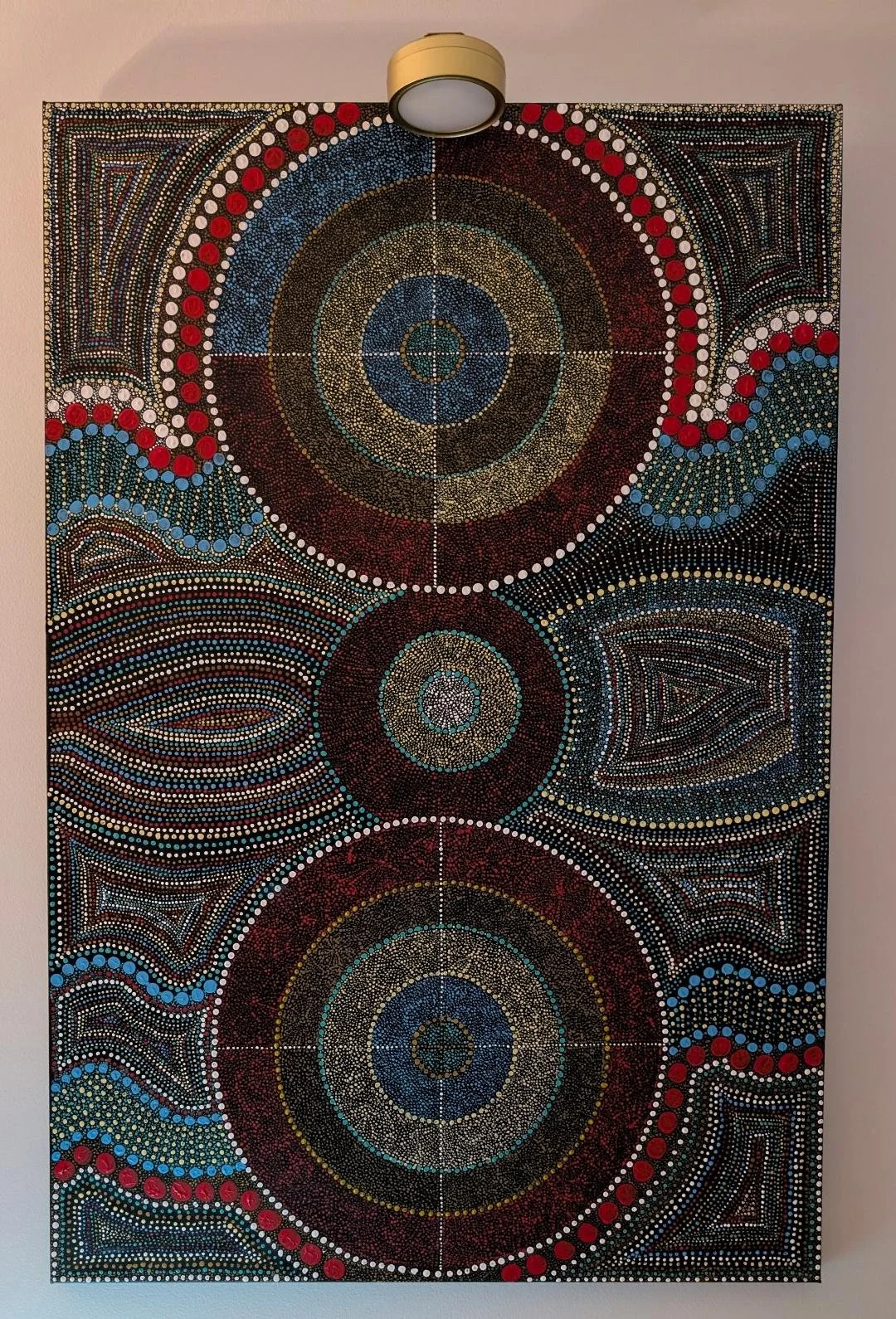
24 x 36. Acrylic on canvas
This painting is a striking example of Australian Aboriginal dot art, a contemporary style that originated in the Western and Central Desert regions in the 1970s (notably from the Papunya community) but draws on ancient Indigenous traditions of symbolic storytelling.
The entire canvas is covered in meticulously applied dots of varying sizes and densities, creating a textured, shimmering effect typical of this style. The composition features multiple large concentric circles (circles within circles) as focal points—there are at least five prominent ones of different sizes arranged vertically and asymmetrically across the canvas. These circles are interconnected by flowing, wavy lines, curved patterns, and dense dotted fields that fill the background.
The predominant colours are deep reds, blacks, and dark browns for the backgrounds and outer rings, contrasted with blues, turquoises, whites, and pale yellows/golds in the inner layers and accents. Bold red and white dotted borders outline many elements, adding vibrancy and definition. The overall tone is rich and earthy, with cooler blue tones providing contrast against the warmer reds.
In Aboriginal art, concentric circles commonly represent significant sites such as waterholes, campsites, meeting places, or sacred ceremonial grounds. The linking patterns and lines often depict journeys, travel paths, or connections between these sites. The dense dotting not only creates visual depth but historically served to obscure sacred meanings from outsiders while conveying Dreamtime stories (ancestral creation narratives).
The painting has a symmetrical yet dynamic balance, with a hypnotic, almost three-dimensional quality due to the layered dotting and colour gradients. It evokes the vast Australian desert landscape—sandhills, underground water sources, and spiritual energy—while maintaining an abstract, non-figurative style.
24 x 36. Acrylic on canvas
This painting is a striking example of Australian Aboriginal dot art, a contemporary style that originated in the Western and Central Desert regions in the 1970s (notably from the Papunya community) but draws on ancient Indigenous traditions of symbolic storytelling.
The entire canvas is covered in meticulously applied dots of varying sizes and densities, creating a textured, shimmering effect typical of this style. The composition features multiple large concentric circles (circles within circles) as focal points—there are at least five prominent ones of different sizes arranged vertically and asymmetrically across the canvas. These circles are interconnected by flowing, wavy lines, curved patterns, and dense dotted fields that fill the background.
The predominant colours are deep reds, blacks, and dark browns for the backgrounds and outer rings, contrasted with blues, turquoises, whites, and pale yellows/golds in the inner layers and accents. Bold red and white dotted borders outline many elements, adding vibrancy and definition. The overall tone is rich and earthy, with cooler blue tones providing contrast against the warmer reds.
In Aboriginal art, concentric circles commonly represent significant sites such as waterholes, campsites, meeting places, or sacred ceremonial grounds. The linking patterns and lines often depict journeys, travel paths, or connections between these sites. The dense dotting not only creates visual depth but historically served to obscure sacred meanings from outsiders while conveying Dreamtime stories (ancestral creation narratives).
The painting has a symmetrical yet dynamic balance, with a hypnotic, almost three-dimensional quality due to the layered dotting and colour gradients. It evokes the vast Australian desert landscape—sandhills, underground water sources, and spiritual energy—while maintaining an abstract, non-figurative style.